Dear Readers,
After a long break, I'm back!
Many bad things happened since my last post. We had a global monster called ISIS, for example. How I missed summers when I could write about figs and Ramadan celebrations... Now its suicide bombs, military coups, corruption scandals, and terrible, I mean, terrible air travel...
I believe scholars of International Relations need extra compensation these days. Perks such as spa packages, alcoholic drinks or mini retreats would really help.
Most of us are depressed and borderline suicidal... Just look at any news site or Twitter, and you'd get all your spirits sucked out of you, as if you've encountered a Death Eater from the Harry Potter books...
In case you were wondering, I'm about to get to the topic of my blog entry: public toilets in Denmark!
So your humble author took a short vacation in Europe this summer.
It all started with collecting mountains of paperwork and a personal visit to the German Consulate in Chicago in April, for a tourist visa. The lady at the consulate was not convinced that my tenure-track job & salary in the US were strong enough credentials to visit her beloved Germany. (Hope my bosses read this before our pay raises.) So I had to have other folks in the group to vouch for me:
1 American and 2 Norwegian citizens. Only after receiving copies of their passports and written testimonies that I am who I am, and really, can afford the trip, I got a precious 14 day Schengen visa.
Fast forward, after a visit to the house where Karl Marx was born (in Trier), we moved up to Denmark.
During the 2016 election cycle in the US, Mr. Bernie Sanders had created a real hype about the place. The way Sander's had described, Denmark was the golden standard of social democracy, wherein all your social needs were met by a generous state, and everyone was enlightened, affluent and above average...
So we drove from Holland to Denmark. Unlike all the other European countries where you just keep driving on the same highway and voila, you're in Belgium, France, or the Netherlands, the road sign says; in Denmark there was police check point on the highway. They look at every car, and waive you in.
In Denmark, we stopped at the first gas station we saw. Danes stick with their Kroner so you better remember your multiplication table really quick. My son had a hamburger. This precious Danish burger at the gas station cost us about $15. And, they charge extra for catchup... about $1. Yes, we learned the hard way.
We moved on, trying to get to the little "summer town" to meet our friends. In this town, we visited two big grocery stores, and neither had a bathroom for customers. Then, we started driving around, thinking that the haven of Mr. Sanders would surely have public bathrooms scattered around this little tourist town.
After quite a bit of driving, we saw ONE sign. Following the sign carefully, we arrived at the site. I jumped out, hoping to find maybe a fancy Toto (some models as much as $10,000), since we're in one of the most affluent nations on earth..
Alas, the bathroom door wouldn't open. But there was a ton of cryptic writing on the door. I tried couple of times, no, the door wouldn't budge.
Finally, I looked at the writing again. Amongst all the Nordic languages, there was a tiny line in English: To use the toilet, send an SMS to xxx123.
You've got to be kidding!!!
So in the social democratic haven, you need to first have a cell phone, and secondly, a plan that works in Denmark, to have access to a public toilet!
What about old people? My mom cannot send SMS messages... What about young kids? Why would everyone has to have a cell phone? What about the mother who's juggling a toddler, a baby and a stroller?
Say anything about the vicious capitalism in America, but at least the public bathrooms are available and accessible to ALL public, regardless of your cell phone coverage!
Back to Denmark:
So I did not want this horrid toilet experience cloud my judgement. But after a week in this "summer town" in Denmark, and a day in Copenhagen, here is my bottom line:
- the whole country is like an empty Ikea store: good, clean design & furnishings, no soul.
- outside Copenhagen, hardly anyone is on the streets or in their yards
- bicycles rule the roads, they're even used as family vehicles
- even in July, it is impossible to swim! way too cold
- most signs are in Danish & other Scandinavian languages
- life is hard for just English speakers
- mobile coverage is needed to use public bathrooms
In short, before you wholeheartedly endorse an ideology, make sure to see one place it is practiced:
Free trade neo-liberals, check out London and it's exorbitant housing market.
Libertarians, see Idaho.
Feel-the-Bernistas, see Denmark :)
May your airport lines be short, and flights uneventful.
Academic Mommy
Showing posts with label EU. Show all posts
Showing posts with label EU. Show all posts
Monday, August 8, 2016


Monday, October 15, 2012
It is the Economy, Stupid!

Lately, problems about Syria seem to have monopolized our
attention.
Instead of speculation and sectarian
gambling in the MidEast, let me distract you towards some bread and butter issues, my dear readers…
Recently, one of the largest business
associations in Turkey called MUSIAD
had its annual convention in Istanbul.
Popularly, MUSIAD is known as the ‘Muslim’
Industrialists & Businessmen Association in Turkey, even though the ‘M’ in
their acronym stands for ‘Independent’ in Turkish.
The Uber-Prime Minister Erdogan gave a speech at the MUSIAD Convention.
The highlight of his speech:
Lamentably
low commercial ties among the world's Muslims.
 According to the Turkish Prime Minister,
the Muslims in the world should wake up and realize that they form a whooping 22% of the world population!
Subsequently, they should circle their wagons and start buying and selling from
each other.
According to the Turkish Prime Minister,
the Muslims in the world should wake up and realize that they form a whooping 22% of the world population!
Subsequently, they should circle their wagons and start buying and selling from
each other.
Now, isn’t that grand? How come no one
came up with this brilliant idea until Tayyip-the-Nuevo-Leader-of-World-Muslims
uttered it?
After the Prime Minister’s speech calling for
the “Muslims of the World, Unite!” the head of MUSIAD obviously got the
message.
In his speech, MUSIAD President Olpak
happily announced that the trade volume of Turkey with the European Union (yep, the one Turkey is a candidate to join since
1999) was going down.
No doubt with the help of God Almighty,
the trade volume of Turkey with the Middle East and other Muslim countries in
Asia and Africa was on the rise!
The Head of MUSIAD is not cooking up these
numbers. The import-export trends in recent years clearly show that Turkish
economy is gradually decoupling from
Europe. For the first time last year, the trade volume with the EU fell below 50%. Russia, Asia and
MENA countries are inching their way up, gradually becoming more important
trade partners for Turkey.
Should we worry about this?
Yes...Here is why:
We have a saying in Turkey: Tell me who your friends are, and I’ll tell
you who you are.
This principle is applicable to imports and exports: Tell me who your export partners are, and I’ll tell
you how advanced your economy is.
When Turkey exports to Europe, or to any
other advanced economy (Australia, Canada, etc), that means those Turkish
products that reach these markets, meet higher
standards. Almost always the EU has higher consumer, environmental,
and quality standards than say
India, China, Saudi Arabia or Pakistan.
Hence, when Turkish economy performs in
order to meet the EU standards, it is compelled to improve itself. The target
market inevitably creates a progressive
dynamic for the Turkish economy.
Let’s look at our fellow Muslims, who
after all form 22% of the world population and grow more rapidly than anyone
else.
Last time I checked, none of the majority
Muslim countries had established advanced industrial economies, including the oil-rich, taxis-are-all-Mercedes
city-states of the Gulf.
Worse, many of them, such as Yemen, are at the bottom of the Human
Development Index. This means, their populations are poorer, less educated
and live shorter. The state of women in these countries is not what
you’d call decent.
Here is an example of what economic
delinking from the West and cozying up to our fellow Muslims would look like in
practice:
Instead of producing TV screens,
electronic components, car parts, sophisticated pharmaceuticals, and organic
fruit for Germany, France or Italy, Turkish economy would produce electric
blankets, aspirin, carpets and furniture for Libya, Iraq, Pakistan and Syria
(assuming things there calm down soon).
You don’t have to be a rocket scientist to
realize that the products aimed for the EU markets have higher technology components to them. Consequently, they have
higher profit margins, greater potentials for R & D, innovation and
advancement. You can be only so sophisticated and innovative, while making
carpets and furniture.
This is only one problem about steering Turkish economy away from advanced
economies, towards lesser-developed ones.
Here are two more:
What would the Prime-Minister &
Co-Chair of Dialogue Among Civilizations think, if the US President called for solidarity among the Christian economies in the world??
Imagine Obama saying: “My fellow
Christians. Today, let’s forget our differences as Protestants, Catholics and
Orthodox. We are more than 2 billion people. Let us combine our economic forces
into a single global Christian economic community!”
Sounds weird, does’t it.
According to the Pew Research Center, 2.18
billion Christians make up almost 1/3 of world population. That’s a pretty
sizable market. But you never hear
any sensible political leader calling for economic cooperation based on religion.
Even Hugo Chavez has more common sense. Across Latin America, which shares common Iberian and Catholic ties, Chavez advocates
unity based on Bolivarianism and socialism, that is, ideology not religion.
Why?
Because, this is the 21st
Century! Hello??? It is discriminatory
and wrong to advocate your cause
-let alone call for economic integration- based on religion.
Finally, there is the World Trade
Organization.
WTO is a free trade organization among
nations. It guarantees that the members play according to the logic
of free trade, which means being rational actors.
As such, WTO prevents favoritism and discrimination
among countries in their economic affairs. In short, it tells that if
you’re a member, you cannot discriminate
the Australians because of their
funny accents, nor can you favor the
Italians, oh because they’re so hot! :))
Back to serious business:
Turkey signed the treaty and became a
member of WTO in 1995.
Erdogan’s suggestion of favoring Muslim
countries in foreign trade is ultimately a violation of the treaty obligations
that Turkey signed onto. As the head of executive, and an advocate of market economy, he should know better.
Below is an excerpt is from the WTO
mission statement.

“Through
these agreements, WTO members operate a non-discriminatory trading system that
spells out their rights and their obligations. Each country receives guarantees
that its exports will be treated fairly and consistently in other countries’
markets. Each promises to do the same for imports into its own market.”
I'm not suggesting we should turn our backs to any economy that is worse off than Turkey.
But this shouldn't come at the expense of economic rationality, and undermine long-term development capacity of the country. Nor should primordial ties like religion, ethnicity or race be the basis of economic solidarity.
Wishing you all rational and
non-discriminatory economic decisions,
The bread & butter advocate, Academic
Mommy
Wednesday, November 23, 2011
Visiting the Brazilian Ambassador:

Photo: Ministry of External Relations (The Itamaraty Palace) in Brasilia, Brazil
Today, I had a nice long visit with the Brazilian
Ambassador. As usual, we covered many topics ranging from PetroBras to black
labs... But my entry is not about the content of our conversation. Rather, I’d
like to talk about political cultures.
Throughout my academic career, I had the opportunity to
encounter and work for some high profile individuals. At my Alma Mater,
Bogazici University, for instance, I was the assistant for the then vice-rector,
who got degrees from Yale and Stanford.
When working at the University of Hartford in Connecticut, I
had the chance to meet with the ex-president of Mexico, Ernesto Zedillo. We had
a nice chat about my dissertation with Dr. Zedillo, who incidentally has PhD
in Economics from Yale.
My last rector in Turkey, who was recently promoted to be
the head of the highest scientific research institute of the country, received
his PhD from Georgia Tech. He was both the sharpest and most accessible administrator that I ever worked with.
Here is where I am trying to get at:
When I look at the high profile people that I interact with,
the ones that I communicate with utmost ease all have some education
experience in the US. Therefore, it wasn't a great surprise for me when the Ambassador said he too had studied in the US.
I think the higher education system in the US, particularly
the Liberal Arts tradition, is the best form of soft power that the US could ever achieve. It breeds a unique blend
of cosmopolitan individuals, who acquire the pragmatic, laid-back, no-nonsense
attitude that is emblematic of the American political culture.
Let me put this in a comparative perspective, so that the
contrast would pop out more:
In my home country, which is not much different from the
other members of the developing word, protocol and hierarchy are strongly
entrenched qualities in political culture. The higher up in the ranks you go,
the more stiff you get. Consequently, it is really hard to have a genuinely
open, productive communication with these people…
Unfortunately, the Europeans are not immune to this
stiffness virus either. Their strong adherence to bureaucracy (see the colossus
they’ve created called the EU), the meandering way they talk, which involves so
many subtle connotations that you need a decoder to capture them all, make it
really hard to get to the nuts and bolts of an issue.
There has been a growing literature on the American decline since the 1980s.
Yet, most of these were coming from the left-leaning IR scholars, hence were not
taken too seriously by the mainstream. Recently however, even the centrist,
mainstream scholars are talking about the “US decline”. (Here is a great piece
by Stephen Walt of Harvard)
Hard power (military and economy) is a whole other issue.
But if it wants to maintain its soft power,
the US cannot afford to lose its global edge in higher education.
My humble suggestion:
Get the public university budgets off the butcher block, and stop the intimidating visa procedures for international scholars and students. What all these end up doing is undermining the precious US soft power in the long run...
Happy Thanksgiving!
The Liberal Arts loving Academic Mommy
Monday, May 3, 2010
I Owe You, You Owe Me, We’re A Happy Family…. Some Thoughts on Greece’s Financial Plight and the EU
The current economic crisis in Greece brought back memories of a trip from a decade ago. Academic mommy is taking the liberty to share some of the highlights of this memorable trip with you. Now, fix yourself some cold frappe (shake instant coffee with some milk until it turns into foam, then add more milk/water and ice cubes) and enjoy the ride:
During the summer of 2000, we drove from Turkey to Northeastern Greece with some friends. We stayed in small, idyllic coastal towns along the way until we reached Thessalonica, which was some 700 kilometers from the border. Thessalonica seemed like a busy city with bustling traffic, air pollution and feisty people, so we rushed back to those peaceful little towns along the Mediterranean -Kavala and Alexandroupolis- to enjoy our vacation.
Our surroundings resembled a movie scene, so much so that I had to pinch myself at times. The towns were extremely picturesque with sparkling clean streets, flowers bursting out of windows, old ladies sitting outside and making embroideries and cats strolling casually…
The houses were exceptionally pretty and well-kept, motor traffic minimal and the towns gently embraced the sea. Every house seemed like a lively primary residence, blending in with its surroundings and covered with lush vegetation. There were no eyesore high rises or ‘walls of privilege’ that isolated neighborhoods and blocked access to the waterfront. Nor were there any traces of characterless summerhouse condos. Unfortunately, those monstrosities have devastated the eastern coasts of the Aegean. Seemingly endless cement cubes that remain empty most of the year have taken over what used to be orchards and olive gardens. Yet, most members of the Turkish middle class are proud owners of these “summer cubicles”, without even a hint of lament in their psyche…
In Kavala, we asked a guy buying a paper from a newsstand if he knew any decent hotels nearby. The place he recommended was a lovely, clean and quiet hotel, which had the most beautiful views when you opened up the French doors in the morning. The kind of place that entices you to become a writer… Too bad my family lacked the requisite real estate stockpile to afford my literary a career… Anyways, both times we were at this hotel (on the way to and from Thessalonica), they forgot to include our breakfast -which was extra- on the bill when we checked out. We noticed this as we were walking away and returned back to pay for it. The old gentleman who owned the place smiled at us and said ‘no important’.
OK, the memories were wonderful, but how does all this story telling relate to the current economic crisis in Greece? Hang on, I'm just about there:
· The whole time we were in Greece, the only businesses that were open during the day, as well as at night were: taverns, restaurants, bars and coffee shops. They seemed to be open round the clock. And were never short of customers, who were mostly locals.
· It was extremely difficult to find open stores, particularly the boutiques, jewelry stores, bookstores, stores that sold handcrafts and fabrics, etc. On weekends, they were closed. Weekdays in the morning, closed… Noon, of course it’s too hot, closed… Afternoon, closed… Some of them cared to open after 4 pm or so, very briefly, and then closed…
· We saw some of the most beautiful silk table clothes and scarves, but I could only watch them through the shop window. None of the stores that displayed these lovely items were open the whole week we were there.
· The business owners that we encountered (mostly the restaurant, hotel and coffee shop owners) seemed at ease with money. They displayed no stress at all to earn more or make the ends meet. They were pretty laid back, almost Zen like, in terms of the way they ran their businesses. Needless to say, this no hassle attitude made our experience in Greece super pleasant.
· People were like Lake Wobegon gone Greek: all the women looked slim and elegant –despite the super greasy moussakkas; all the men handsome and affluent, and all the children happy… They must have done something to hide all their depressed and impoverished because we hardly saw anybody who did not seem content with their lives…
· The class ladder in northern Greece seemed to start from the middle section and then went up. The younger generations looked more fashion savvy and sported expensive brands. However, even the soberly dressed old ladies with their black dresses and black headscarves lived in beautiful homes in smart neighborhoods.
· Most people seemed to be eating and socializing out. The norm was enjoying long long meals in those ubiquitous taverns. For us, it was a great relief to not have waiters whisking away our half empty plates and glasses, in a rush to seat the next unfortunate batch of tourists
Of course, one needs to take such touristic observations with a grain of salt. At times, they might easily turn into blind men describing an elephant. It is only a snapshot of reality, taken during a limited period of time and with very limited contextual knowledge by the observer. Despite all the usual cautionary measures, however, I remained puzzled over how Greece could achieve such high standards of living.
My sense is, either the Greeks managed to create the heaven on earth, where “there’s a lake of stew and whiskey too”, and where “they hung the jerk that invented work,” like they did in the Big Rock Candy Mountain.. :) Or, they were just running the show on borrowed money….
Recent financial turmoil in Europe signals that the second option is more plausible. Invited to help clear the mess, the IMF officials express outrage over many aspects of Greek economy such as:
· the size of public sector in Greece: no one can give a definite number as to how many people are on the public pay roll. Some claim it is greater than the size of state sector in Eastern Europe under socialism!
· generous bonuses: Everyone gets two moths pay as bonuses each year, now isn’t that grand?
· “flexible” work hours: so flexible that you can show up to work whenever it is convenient for you…
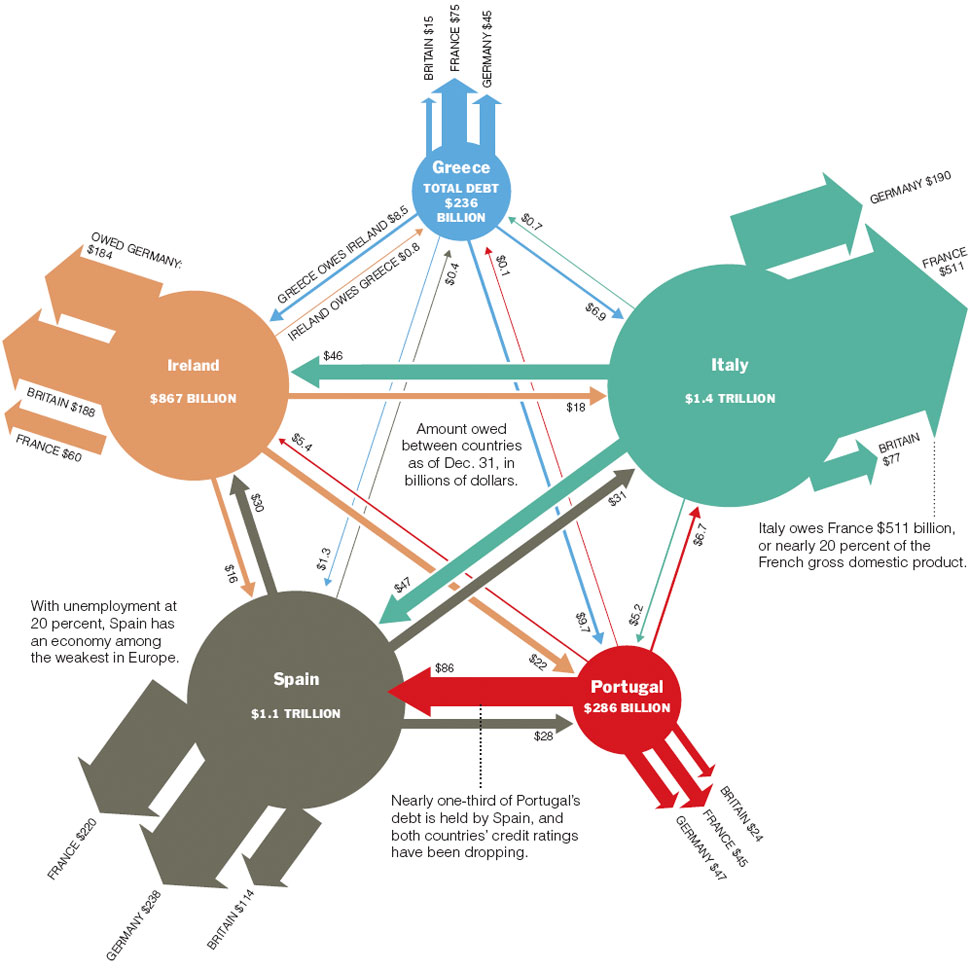
Despite the recent vilification of Greece in global press, the above graphic by the New York Times hints that the Greeks are not alone in Europe when it comes to financing their affluence out of their friendly neighbors’ pockets. When you look at the arrows, it portrays an intricate web of “I owe you, you owe me” type of relations across the extended family of core EU countries. Spain, Portugal, Ireland and Italy also seem to be riding on this generous debt tide. Furthermore, the width of the debt arrows indicates that Germany, France and Britain are the largest bearers of this financial burden. No wonder why Sarkozy and Merkel sound so grumpy lately…
Let me not finish without pointing finger at the usual suspects: Global finance capital. Interestingly enough, some of the corporate actors that offered “creative” financial advice to the Greek government were the same ones that were responsible from the implosion of the finance sector in the US. Small world, isn’t it?
Financial crises are the real testing times for all families. Whether it is the irresponsible son frittering away the family savings on girls and booze, or the unfortunate father who looses the family business after a wrong investment choice, it all boils down to the strength of their solidarity as a family. What we are observing is not individual meltdowns in Greece, Spain or Ireland. More importantly, it is a test for the EU to prove itself.
If the EU can resolve this crisis and bring its house in order, it will confirm its position as the only viable supranational body in the current international system. However, if the EU fails and Greece is left to its own devices, I strongly recommend the Greeks to get friendly with the Brazilians. As a country that paid off its IMF debt earlier than scheduled and subsequently enjoyed great economic boom, Brazil might offer valuable advice to Greece when dealing with the IMF.
Subscribe to:
Posts (Atom)